Providence Santa Rosa Memorial Hospital Provides Life-Saving Cardiac Care Closer to Home
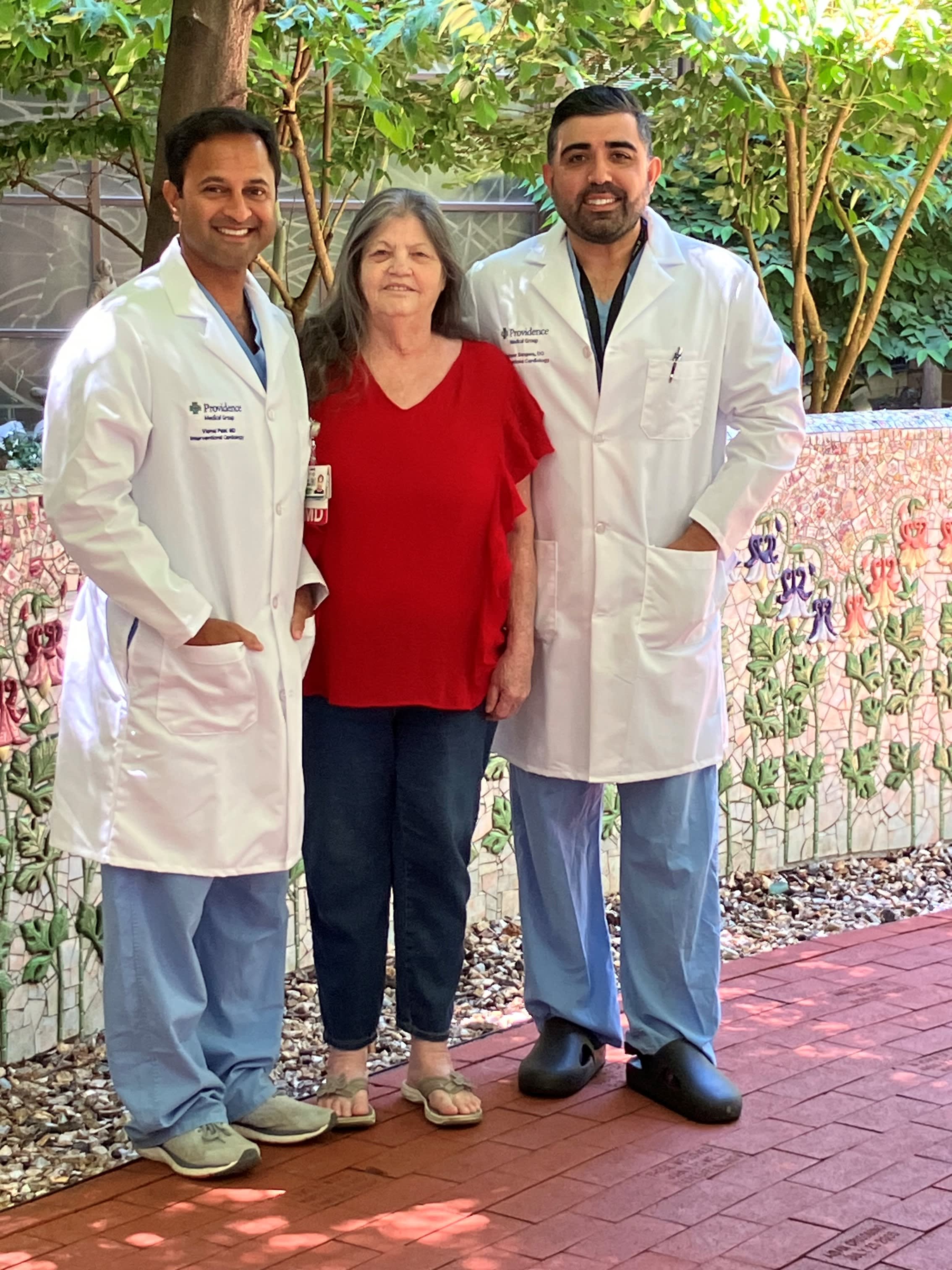
Heart disease continues to be the leading cause of death, claiming one in every five Americans. Someone in the United States has a heart attack every 40 seconds, and when a heart attack strikes, it’s crucial to get expert care as quickly as possible. Fortunately for the residents of Sonoma County, Providence Santa Rosa Memorial Hospital has one of the best cardiac care teams in Northern California, as well as three state-of-the-art catheterization labs (cath lab).
Interventional cardiology advances give patients higher survival rates using less intrusive treatments and procedures. While many patients traditionally required open heart surgery, interventional cardiologists are doing more with minimally invasive catheterization techniques. That includes those with rare conditions such as MI VSD. Santa Rosa resident, Irene Harper, for one is grateful for the advanced cardiac care at Santa Rosa Memorial Hospital, having survived post-MI VSD, a condition that is usually fatal.
What is Post-MI VSD?
A ventricular septal defect (VSD) is a complication that follows a myocardial infarction (MI) or heart attack. Following an MI, a hole develops in the wall that separates the two lower ventricles or heart chambers. It’s a rare condition with a high mortality rate.
A lack of blood flow to the heart causes an MI. These days, interventional cardiologists treat MI’s using cardiac catheterization, inserting a catheter usually from the wrist or groin to unblock arteries to the heart and restore blood flow. Unfortunately, even with rapid recognition of an MI and urgent initiation of cardiac catheterization, VSDs can still occur.
“It’s becoming rarer now,” said Rajveer Sangera, DO, an interventional cardiologist and co-director of the Structural Heart Program at Santa Rosa Memorial Hospital. “Twenty or 30 years ago, it was much more common to see these complications. Now we have national MI timelines/protocols, better medicines and our equipment is better which has minimized post MI complications. But in spite of these advances, we still see post-MI VSD’s, and the patient’s risk of death is very high.”
Approximately 0.2% of MI patients develop a VSD, which can manifest from one to 14 days after a heart attack. Without treatment, a VSD can cause edema or fluid trapped around the heart, cardiogenic shock, where the heart can’t pump enough blood, and heart failure. Without treatment, MI VSD has a 90% mortality rate.
Physicians traditionally treat VSDs surgically, but many recovering heart-attack patients are considered too high-risk for surgery. The cardiologists at Memorial Hospital successfully treat VSD patients using catheter-based closure, a procedure increasingly used to treat MI VSD. Such procedures have a 71% to 89% success rate.
Successful Treatment of a Life-threatening Complication
Irene Harper, 73, suffered a heart attack. She went to Kaiser hospital with chest pain, and was sent her to Memorial Hospital for treatment. The cath lab successfully inserted a stent in her blocked artery to increase the flow of blood, which gave her immediate relief.
Following the procedure, Irene was stable but then started to develop signs of heart failure. An echocardiogram revealed the post-MI VSD and the cardiac team had to consider options to close the hole in the ventricle wall.
Surgery was inadvisable. After an MI, the heart tissue is damaged and becomes soft, so it can’t accept sutures. With the risk from surgery being too high, the team opted for another catheterization procedure.
Providence cardiologists used a catheter to insert a device that places a disc on either side of the ventricle wall to occlude, or block, the hole. The cardiologists performed the procedure without open heart surgery in under an hour, and Irene was released two days later.
“The care was excellent – the nurses, the doctors, everybody,” Harper said. “It was absolutely mind-blowing. Even my family members commented on it.”
Irene’s procedure was the first catheter-based VSD closure done in Sonoma County.
A World-Class Cardiology Team Close to Home in Sonoma County
Having three state-of-the-art cath labs puts Memorial Hospital in a unique position to treat unusual complications like post-MI VSD.
“We offer comprehensive cardiac services,” said Vishal Patel, M.D., an interventional cardiologist and co-director of the Structural Heart Program at Santa Rosa Memorial Hospital. “The development of this program over the past few years has given us the ability to take care of more complex patients and keep them local rather than sending them out.”
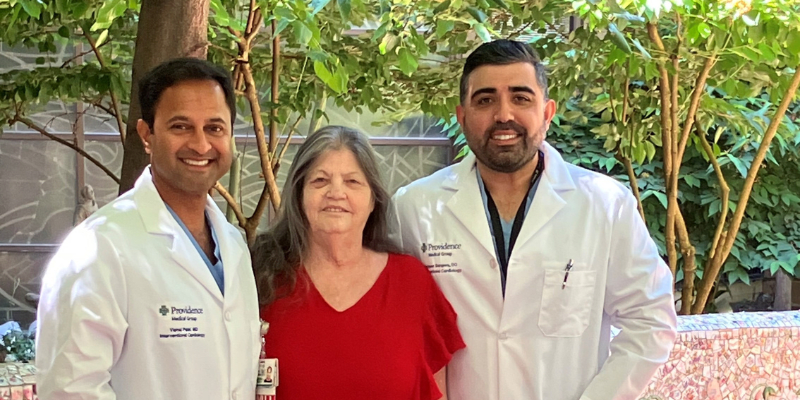
Drs. Sangera and Patel are quick to praise the entire team at Memorial for their care of cardiac patients, including the nursing staff and post-operative team.
“We have a good cardio team, but it’s the hospital care, too,” said Dr. Patel. “The cath lab team is the best I’ve ever worked with. We really trust them when we bring patients here, and we know they are getting good care.”