Shared Governance and Nursing Professional Practice Model
The purpose of shared governance is to create a culture of nursing excellence that supports the mission, vision and values of Providence Little Company of Mary Medical Center San Pedro. As a partnership between clinical staff and nursing leadership, shared governance will support and facilitate quality and evidence-based nursing care for patients, families and the community.
Providence Little Company of Mary Medical Center San Pedro’s shared governance council structure:

- Clinical Practice Council (CPC)
- Coordinating Council (CC)
- Nursing Research Council (NRC)
- Professional Engagement Development Recognition Opportunities (PEDRO) Council
- Transformational Leadership Council (TLC)
- Quality and Safety Council (QSC)
- Unit Based Councils
Council Guidelines: 80% Direct Care Nurses, 20% Nursing Leadership (Exception TLC)
Hospital Committees
Hospital committees that address specific areas where Nursing has representation. Those areas include:
- Code Blue/Rapid Response Team Committee*
- Diversity Equity and Inclusion Committee
- Falls Committee*
- Green Team*
- Medication Safety Committee
- Operations Meeting
- Patient Experience
- Quality and Patient Safety Committee
- Readmissions Steering Committee*
- Sepsis Steering Committee*
- Strategy Huddle
- Stroke Committee*
- Workplace Violence Prevention Committee*
*Chaired or co-chaired by a nurse
Nursing Professional Practice Model
Our Nursing Professional Practice Model is the driving force behind nursing care at Providence Little Company of Mary Medical Center San Pedro. We created a schematic depiction of the theories and systems that guide professional development, collaboration, communication and the delivery of high-quality care to those we serve in our hospital.
The model guides our decision-making, aligns nursing practice and supports recruitment and retention of nurses across the hospital by providing a visual representation of how we deliver patient care.
Our model is grounded in two complementary nursing theories: Jean Watson’s Philosophy of Nursing based on her theory of human caring, and Patricia Benner’s novice-to-expert theory based on her book From Novice to Expert: Excellence and Power in Clinical Nursing Practice. Our model illustrates how nurses develop professionally and how they communicate and relate with patients, families, communities and the interdisciplinary team.
Both theories were thoughtfully integrated to create a model unique to Providence Little Company of Mary Medical Center San Pedro – putting care and compassion at the forefront.
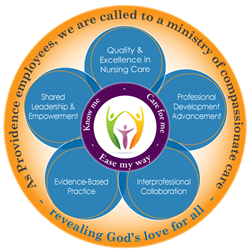
We see leadership as a shared endeavor between our leadership teams and clinical nurses. It is designed to maximize professionalism in nursing practice.
Nurses promote quality and safety in nursing care. They take accountability for high-quality outcomes.
We promote opportunities for nurses to grow into the professional nursing role with collaboration and competence. We encourage and reward their participation in academic progression, national certification and ongoing continuing education programs.
Within this context, collaboration is a necessary component to professional growth. Team members bring valuable expert resources to the care of patients and families.
By using the systematic study of actions and phenomenon relative to the practice of nursing, we can greatly enhance nursing practice and patient care outcomes.